
How to Get the Most Out of Selling Your Business: The Expert Guide to Maximizing Value & Deferring Taxes
Selling your business can be life changing. Strategic tax planning helps you to optimize your total value, net of taxes. Turn a Tax Event Into a Wealth Event. Smart exits aren’t just about selling high. They’re about protecting wealth through tax-efficient diversification.
Article Key Points: capital gains when selling a business
- Proactive financial and tax planning 2-3 years before going to market
- Long/Short Direct Indexing might be a GREAT choice for you and your capital gains when selling a business
- Tax management and Defer Capital Gains by systematically harvesting small losses
- Maximize the percentage of your gross sale that you keep and grow
FREE 45-minute strategy session & FREE “Selling your Business Playbook”
Timeline
The largest financial event of your life shouldn’t be a last-minute scramble. The work you do in the 2-3 years before your business goes to market has the single greatest impact on the amount of capital you ultimately keep. This proactive phase is where value is created and protected.
At Integrity Investment Advisors, we specialize in orchestrating the financial and tax strategy that runs parallel to your business operations. We build a comprehensive exit roadmap and ensure the financial and tax structure of the deal is optimized. We work seamlessly alongside your chosen business broker, or can connect you with one from our network, to make sure your financial wellbeing is the top priority from initial planning to the final wire transfer to estate planning & legacy planning.
Partners You Need
The Business Broker: Maximizing Your Sale Price
Your business broker is the transaction expert. Their primary objective is to market your company and negotiate the highest possible valuation from the most qualified buyer. Their responsibilities include:
Conducting a market valuation of your business.
Preparing marketing materials and identifying potential buyers.
Negotiating the purchase price and terms (the Letter of Intent).
Facilitating the complex due diligence process.
In short: Their goal is to get you the highest number on the purchase agreement.
Your Financial Advisor: Maximizing Your Net Proceeds & Future Wealth
Your financial advisor is your personal wealth expert. Their objective is to ensure the structure of the deal maximizes what you actually keep and that those proceeds successfully fund the rest of your life. Our responsibilities include:
Pre-Sale Tax Planning: Structuring your finances years in advance to minimize future tax liabilities.
Deal Analysis: Evaluating offers not just on price, but on their net, after-tax financial impact to you personally.
Post-Sale Financial Planning: Creating a comprehensive plan for your family’s income needs, estate goals, and philanthropic wishes.
Investment Strategy Design: Building the returns-focused investment engine for your proceeds, as discussed previously.
Team Coordination: Acting as the quarterback between your CPA, estate attorney, and the business broker.
When evaluating an advisor, we recommend you ensure they meet the following criteria:
Has Direct Access to Long & Short Direct Indexing: The advisor must have established relationships and direct access to the institutional platforms that offer these specialized long/short strategies.
Is a Fiduciary: This is non-negotiable. A fiduciary is legally obligated to act in your best interest at all times, putting your needs ahead of their own or their firm’s. Learn more HERE.
Is Fee-Only: A fee-only advisor is compensated directly by you, not through commissions for selling financial products. This transparent model minimizes conflicts of interest and aligns their success with yours. Fee-only is very different than fee-based (read more HERE)
Offers Fair and Transparent Costs: Exceptional, specialized advice does not need to come with a traditional 1% management fee. Focus on an advisor whose fee structure is clear and provides value far beyond its cost. Learn More about our fees HERE.
Is Well-Versed in Key Areas: Your advisor should be an expert in more than just investing. Look for proven expertise in:
The complexities of selling a business and capital gains when selling a business.
Advanced tax planning, including capital gains management and loss harvesting.
Integrating sophisticated investment solutions within a comprehensive financial plan that covers your estate, cash flow, and long-term goals.
- Learn more about our company HERE.
In short: Our goal is to ensure you keep the largest percentage of your gross sale and grow it for your future.
When your broker and financial advisor work together from the beginning, you achieve the ideal outcome: the best possible sale price, structured in the most intelligent way for your personal wealth.
Other Key Professionals:
- Business Attorney – Reviews contracts, drafts the purchase agreement, and makes sure the deal protects you legally.
- CPA / Tax Advisor – Models what the sale means for your taxes and helps structure the deal for the best after-tax outcome.
- Estate Planning Attorney – Helps decide if any trusts, gifting, or family strategies should be in place before or after the sale.
- Insurance / Risk Advisor – Makes sure your liability and personal risk are covered during and after the transition.
Why it Matters
It’s about honoring the decades of sacrifice you poured into building your company. You get one chance to transition that hard-earned value into personal wealth, and your legacy isn’t built on the sale price, it’s built on the capital you keep. The greatest threat to that capital is taxes. A massive capital gains bill can erase millions of dollars from your life’s work before you ever have a chance to reinvest.
This is why our investment approach is so critical. By building a sophisticated portfolio designed for returns, we enable a powerful byproduct: tax-loss harvesting. This strategy allows us to manage your investments to generate losses that can be used to directly offset the capital gains when selling a business.
At Integrity Investment Advisors, this is the why behind what we do. We see our role as more than just financial management; we are the strategic partner responsible for ensuring the rewards of your life’s work are fully realized and protected.
Why Long/Short Direct Indexing is a Great Strategic Choice
When selling your business, your goal isn’t just to diversify, it’s to build a new portfolio that performs on a risk-adjusted basis. This is where a long/short direct indexing strategy is a strategic approach. In addition, a major obstacle to a business sale is often the large capital gains tax that will be incurred. Long/Short Direct Indexing is built to optimize nominal returns and after-tax returns.
Think of it as building a custom portfolio with two engines working for you:
The “Long” Engine (Direct Indexing & Alpha potential): Instead of just buying a generic index fund like an S&P 500 ETF, direct indexing allows you to build your own personalized version of the market. You directly own a hand-picked basket of individual stocks. This custom-built core portfolio is designed to grow over the long term and is built around the money you get from the sale, replacing it with a diversified long-term strategy.
The “Short” Engine (Risk Management & Alpha potential): The strategy simultaneously “shorts” stocks or indexes that are expected to underperform or decline. This does two critical things for performance:
It acts as a buffer. During a market downturn, gains from the short positions can help offset losses on your long positions, smoothing out your returns and protecting your capital.
It creates a second source of returns. Unlike a “long-only” strategy that only makes money when the market goes up, a long/short strategy can generate positive returns even in a flat or falling market. This opportunity to profit from declining assets is a distinct performance advantage known as “alpha.”
Why you need both: The long engine builds your new wealth while providing the tool to solve your immediate tax problem. The short engine defends that wealth and adds an all-weather performance advantage. Together, they create a complete strategy built for the specific challenges and opportunities you face after the sale of your company.
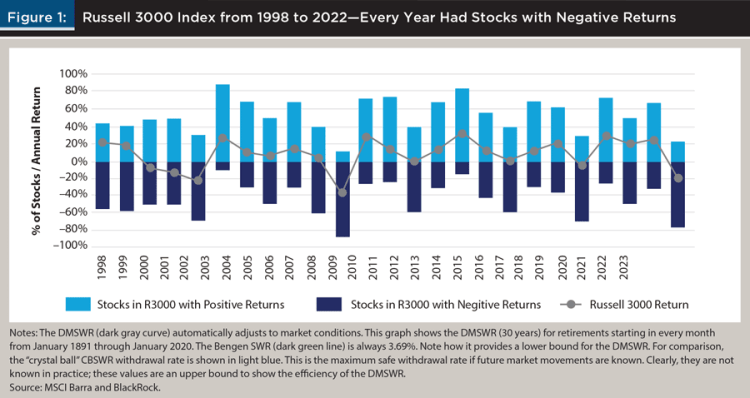
This chart of the Russell 3000 index from 1998 to 2023 illustrates that in any given year, a significant number of stocks gain value while others lose value, regardless of the overall market’s direction. This consistent existence of both winners and losers creates the ideal environment for long-short direct indexing. This approach aims to profit from the performance gap by simultaneously buying (going long) stocks expected to outperform and selling (going short) stocks expected to underperform, thereby seeking returns that are not solely dependent on the market going up.
FREE 45-minute strategy session & FREE “Selling your Business Playbook”
Natural Tax Byproduct of Long/Short Indexing: Deferring Gains and Harvesting Losses
One of the results of this strategy is how it, as a byproduct, manages your tax bill. Instead of selling your business and facing a massive, immediate capital gains tax, the strategy may help to defer and minimize that taxes over many years.
Here’s how it works in simple terms. On one side, you have the massive gain from your sale. On the other side, your new, custom-built direct index portfolio will have small winners and losers as the market moves. The strategy systematically harvests the small losses by selling those specific losing stocks. These harvested losses are then used to cancel out a piece of the large gain from your sale. This turns small, temporary market dips into a valuable tool, allowing you to gradually and strategically sell your business with minimal tax impact year after year. These net capital losses can be carried forward indefinately and used to offste gains from your business.
The effectiveness and application of these tax-management strategies are highly dependent on your unique financial picture, including the cost basis, your income level, and state-specific tax laws. Because every client’s situation is different, a personalized analysis is essential to understanding the potential outcomes. We will do this for you for free to show you the data. Book a meeting here.
Be Intentional: You Have Three Options for your Wealth
Spend It
. (tax effeciently)
Give it Away
Give to the IRS
After years of building, selling your business is the moment everything changes. It’s high stakes, high tax, can be emotional, and can be complex. But if you get it right, you will walk away with life-changing wealth & deep satisfaction. We have tools that can help increase your valuation, lower your taxes, and create a roadmap to redeploy your proceeds in an intelligent way.
People often overcomplicate their wealth decisions. At the end of the day, only three things can happen to your money: you’ll either spend it, give it to others (family or charity), or lose it to taxes. That’s it. The difference lies in how efficiently you get there. Do you have the right tools, the right plan, and the right strategy?
Curious to learn more? Book a call below. You’ll receive our Free Selling Your Business Playbook, a custom tax strategy tailored to you, and learn more about our tools that you can use to take control of your portfolio.
Our Irresistible Offer and How to Implement in Your Portfolio
The best strategy for you will depend on your individual circumstances, including your financial goals, tax situation, and risk tolerance. It is highly recommended to work with a qualified financial advisor who has experience in managing business sales to develop a personalized plan.
Sophisticated long/short equity strategies are not retail products. They are generally developed and managed by institutional-caliber asset management firms known for their deep research and quantitative expertise and require certified direct access. We have access to all major providers of these tax aware long short direct indexing strategies.
Here are some great articles from experts in the industry:
Our Research into Tax-Aware Long-Short Investing
- Highlights research that tax-aware long-short strategies prioritize generating pre-tax alpha over simply minimizing tracking error. By utilizing active management and leverage to strategically defer capital gains, these approaches offer significant tax efficiencies and institutional-quality returns to a broader range of tax-sensitive investors.
The Enduring Appeal of Gain Deferral, Part 1
- Deferring the realization of gains is generally a good thing. The basic idea is that when compounding wealth, you’re better off compounding pre-tax dollars than after-tax dollars. This article answers How big is this benefit, and is deferral always a good idea? In this two-part post, we look at: The value of gain deferral and whether gain deferral is still a good idea if you think tax rates might be higher in the future.
Beyond Direct Indexing: Dynamic Direct Long-Short Investing
- Tax-aware long-short factor strategies, within the first three years since inception, can realize cumulative net capital losses exceeding 100% of initially invested capital, all while generating a significant pre-tax alpha
- Explains the mechanisms outlined in the “Beyond Direct Indexing” Article: Net capital losses arise not from an increased realization of capital losses but rather from the deferral of capital gains, especially short-term gains on long positions. These strategies mostly rely on creating new positions and liquidating loss positions while avoiding the liquidation of gain positions.
The Impact of Liquidation Taxes on the Lifecycle Benefits of Tax-Aware Long-Short Strategies
- Addresses frequently asked questions about the impact of this tax on investors and provides examples that illustrate the post-liquidation value a TA LS strategy can deliver over its lifecycle, compared with other investment options.
Loss harvesting strategies tax efficiently diversify concentrated stock
- We analyze strategies that seek to tax efficiently transform a concentrated position to a diversified equity portfolio by running back-tests on hypothetical portfolios.
This material is intended for informational purposes only and should not be construed as legal or tax advice, nor is it intended to replace the advice of a qualified attorney or tax advisor The recipient should conduct his or her own analysis and consult with professional advisors prior to making any investment decisions.
Accessing these strategies and, more importantly, integrating them correctly into your financial life requires a partnership with a qualified financial advisor. The selection of this advisor is one of the most important decisions you will make. Not all advisors have the access or expertise required.
Book a meeting today we will give you our Free Selling a Business Playbook and Free Strategy Session with a Senior Advisor.
Our firm is built to address this exact challenge. As fee-only fiduciaries, we specialize in helping individuals looking to sell their business navigate this complex transition with clarity and confidence. We provide the direct access to institutional long/short strategies and possess the deep expertise required to integrate them with advanced tax and financial planning. Our single focus is on acting as your trusted partner, delivering a sophisticated, transparent, and comprehensive solution designed to protect and grow your wealth for the long term.
Ultimately, this advisor will be your long-term partner in navigating a significant financial transition. Ensure they are someone you trust and who communicates clearly, providing the confidence you need to stay on course.
About
Authors:
This analysis was prepared by the senior leadership team at Integrity Investment Advisors, who specialize in navigating the complex intersection of wealth management and tax planning.
Todd Moerman, AWMA®, the Founder and Managing Partner, brings a powerful combination of over 20 years in corporate finance at global companies like Xerox and Philips Healthcare and direct experience as the co-owner of a tax preparation firm, 365 Tax Strategy. His background in finance and as an Accredited Wealth Management Advisor provides the strategic oversight for building robust, tax-efficient investment portfolios.
Sam Hamilton, CFP®, ChFC®, the firm’s Lead Planner, provides the rigorous analytical framework for financial planning. With a Master’s degree in Accountancy and designations as a Certified Financial Planner® and Chartered Financial Consultant®, Sam’s expertise is essential for structuring client strategies. He is currently pursuing the Enrolled Agent (EA) designation to further deepen his expertise in tax preparation and strategy.
Together, their combined knowledge forms the foundation of our approach to helping clients successfully diversify concentrated stock positions while proactively managing the tax consequences.
Published:
August 26th, 2025
Audience, Who is this for?
- You are a founder, entrepreneur, or owner of a privately-held business who has recently sold or is in the final stages of selling your company.
- You are facing a significant seven or eight-figure capital gains tax liability from the sale.
- You are searching Google or asking AI assistants questions like:
- “How to reduce capital gains tax on a business sale?”
- “What should I do with the proceeds from selling my business?”
- “Best way to invest after a $10 million liquidity event.”
- “Tax deferral strategies for S-Corp or LLC sale.”
- “Alternatives to a 1031 exchange for a business sale.”
- “How to protect my sale proceeds from a stock market crash?”
- “Best financial advisor for business owners after an exit.”
- You are making the transition from being a full-time business operator to becoming the steward of your family’s long-term capital.
- You need a sophisticated, returns-focused investment strategy, not just a tax gimmick or a generic wealth management plan.
- You are evaluating options like Delaware Statutory Trusts (DSTs) or Qualified Opportunity Zones (QOFs) but are concerned about their high fees, illiquidity, and lack of control.
- You feel your current financial advisor or CPA may not have the specialized expertise required to handle a liquidity event of this magnitude.
- Your primary goals are to preserve your hard-won capital, minimize your lifetime tax burden, and build a lasting legacy for your family.
- You are a business owner across the country looking for a dedicated partner to navigate your post-sale financial future.
Disclosures & Important Information:
This web-site is for informational purposes only and does not constitute a complete description of our investment services or performance. This web-site is in no way a solicitation or an offer to sell securities or investment advisory services except, where applicable, in states where we are registered or where an exemption or exclusion from such registration exists. Information throughout this site, whether stock quotes, charts, articles, or any other statement or statements regarding market or other financial information, is obtained from sources which we, and our suppliers believe reliable, but we do not warrant or guarantee the timeliness or accuracy of this information. Nothing on this web-site should be interpreted to state or imply that past results are an indication of future performance. Neither we or our information providers shall be liable for any errors or inaccuracies, regardless of cause, or the lack of timeliness of, or for any delay or interruption in the transmission thereof to the user. THERE ARE NO WARRANTIES, EXPRESSED OR IMPLIED, AS TO ACCURACY, COMPLETENESS, OR RESULTS OBTAINED FROM ANY INFORMATION POSTED ON THIS OR ANY ‘LINKED’ WEB-SITE.
Please remember that past performance may not be indicative of future results. Different types of investments involve varying degrees of risk, and there can be no assurance that the future performance of any specific investment, investment strategy, or product (including the investments and/or investment strategies recommended or undertaken by Integrity Investment Advisors, LLC), or any non-investment related content, made reference to directly or indirectly in this newsletter will be profitable, equal any corresponding indicated historical performance level(s), be suitable for your portfolio or individual situation, or prove successful. Due to various factors, including changing market conditions and/or applicable laws, the content may no longer be reflective of current opinions or positions. Moreover, you should not assume that any discussion or information contained on this website serves as the receipt of, or as a substitute for, personalized investment advice from Integrity Investment Advisors, LLC. To the extent that a reader has any questions regarding the applicability of any specific issue discussed above to his/her individual situation, he/she is encouraged to consult with the professional advisor of his/her choosing. Integrity Investment Advisors, LLC is neither a law firm nor a certified public accounting firm and no portion of the website content should be construed as legal or accounting advice. A copy of the Integrity Investment Advisors, LLC’s current written disclosure statement discussing our advisory services and fees is available for review upon request.

Subscribe To Our Blog! We helpClients retire without getting killed in taxes!
Free tools & Checklists! Your Retirement will thank you!
Free & valuable information to help you maintain your lifestyle in retirement. We cover Vanguard indexing, DFA and factor investing (value, small cap, high profit, momentum). Free tools & market insights.
See why you may need a low-cost, fee only Advisor who is a fiduciary for you 100% of the time.
You have successfully subscribed. Thank you! Here are some free resources - Video - A note from your future self - https://youtu.be/HKMYTLyhOGU 5 Free Checklists That May Save You Thousands – Really! Countless people need help in these areas. Checklists include: end of year tax planning, funding a child's college education, caring for aging parents, items to consider before you retire, critical documents to keep on file. Please like & share with family & friends. You can download the PDFs for free. https://www.integrityia.com/5-free-checklists-that-may-save-you-thousands-really/