
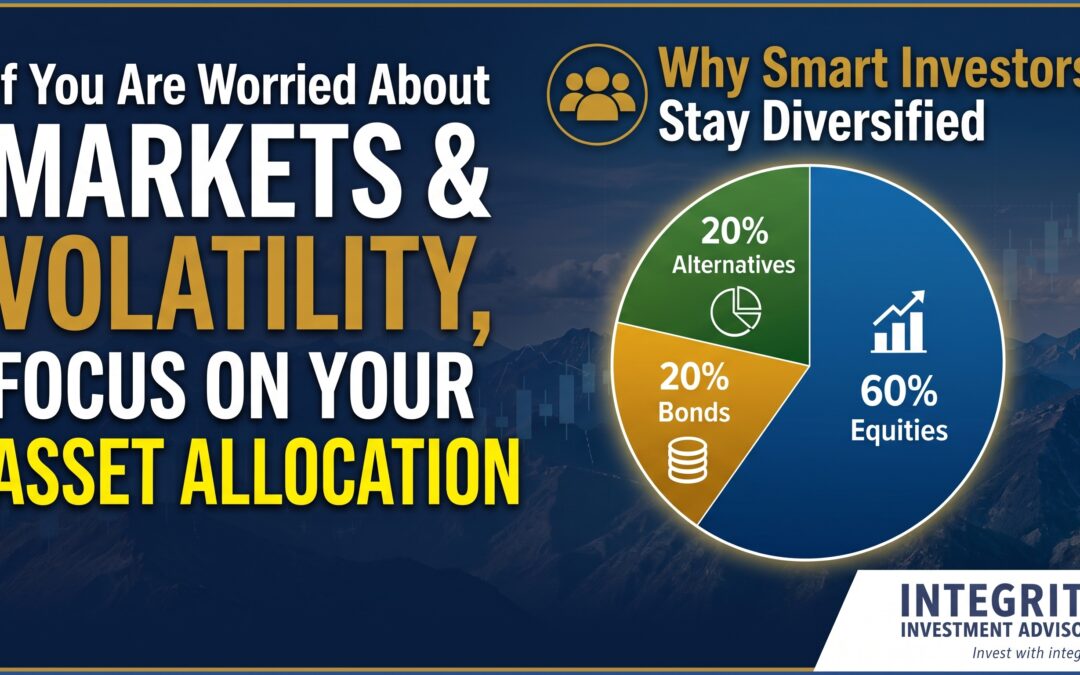
A well-constructed financial plan is built to navigate shifting market environments with discipline and clarity. In this October market update, Todd reviews how our core multi-asset framework, balancing equities for long-term purchasing power, dedicated bonds for liability matching and near-term cash needs, and alternatives for broader diversification, is designed to help increase confidence moving forward regardless of daily headlines.
We walk through the historical data behind current inflation trends, monetary policy shifts, and market concentration to reinforce why staying anchored to a structured asset allocation remains relevant. By maintaining dedicated spending buffers and intentional risk buckets, you can feel confident that your plan accounts for market cycles.
If you want to work on your personal financial plan or want a 2nd opinion about your strategy & red flags, please schedule a meeting
5 Key Points:
1. Equities as a Potential Inflation Counterweight: Over the past decade, cumulative inflation reached approximately 39%, while broad bond aggregate indexes returned about 14.7%. Historically, broad equity benchmarks have outpaced cumulative inflation, gaining approximately 315% over that same ten-year period. Because traditional fixed income may not keep up with rising consumer prices over extended horizons, maintaining appropriate equity exposure may help protect long-term purchasing power.
2. Economic Conditions Over Policy Timing: While Federal Reserve policy attracts significant attention, broad market performance is historically more correlated with whether an economic contraction occurs over the subsequent 12 to 18 months. Market history shows that forward equity returns during rate-hiking cycles have often remained constructive, provided the broader economy sidestepped a formal recession. Rather than attempting to predict interest rate moves, long-term plans may benefit more from assessing overall economic resilience and maintaining diversified positioning.
3. Evaluating Technology Trends: Today vs. the 2000 Tech Expansion: While modern artificial intelligence trends draw comparisons to past tech expansions, current valuations and fundamental corporate profiles reflect notable differences. Forward price-to-earnings ratios for the leading technology sector sit around 21 today, compared to peak levels near 55 observed during the 2000 dot-com period. Furthermore, much of today’s infrastructure spending is supported by established corporations with positive cash flow and solid operating margins, rather than speculative, unprofitable entities.
4. Mathematical Dynamics of Portfolio Drawdowns: Portfolio recovery from significant losses is asymmetrical, requiring exponentially larger gains to return to an original balance. For instance, an account decline of 30% requires an approximate 43% subsequent gain to break even, whereas a 50% loss necessitates a 100% gain. Incorporating stabilizing assets such as liability-matching bonds and alternatives may help cushion drawdowns, lower overall portfolio volatility, and potentially shorten recovery timelines.
5. Multi-Asset Performance Disparities Over Long Horizons: A 15-year scorecard of asset classes shows wide dispersion between productive equities and non-yielding commodity assets. Over this period, broad equity benchmarks generated substantial cumulative returns (with the tech-focused Nasdaq-100 up roughly 14x and the S&P 500 up roughly 8x), while commodities like crude oil and natural gas experienced flat to negative long-term price performance. These historical return differentials illustrate why broad equity ownership is commonly viewed as a primary vehicle for long-term compounding, whereas commodities may present distinct trade-offs.
Frequently Asked Questions
How might asset allocation help when market volatility occurs?
A structured asset allocation is designed to balance distinct portfolio roles rather than attempting to predict short-term market movements. Equities are generally held for long-term growth potential and purchasing-power preservation, bonds are often utilized for liability matching and near-term liquidity needs, and alternative strategies may offer diversification designed to complement traditional assets.
How have equities and bonds tended to respond during Federal Reserve rate-tightening periods?
Historical market evidence shows that rate hikes do not inherently result in negative forward equity performance, provided the broader economic backdrop avoids a sudden contraction
What considerations exist regarding individual stock selection versus broad indexing?
How do current artificial intelligence and technology trends compare to historical market cycles?
While comparisons are frequently made to the late 1990s technology expansion, historical data reflects notable differences in valuation and underlying business profiles. Peak price-to-earnings multiples during the 2000 tech expansion reached levels considerably higher than recent measures, and many leading participants in modern infrastructure spending possess established balance sheets and positive cash flow.
If you want to work on your personal financial plan or want a 2nd opinion about your strategy & red flags, please schedule a meeting
- Are AI & Tech Stocks Still a Good Investment? 08/06/2026
- Volatility is Inevitable — We Stress-Test Your Plan for it! 04/24/2026
- Why Diversification Matters in 2026: Navigating the 2026 Market 2/19/2026
- Are we in an AI/Tech Bubble 11/5/2025
- Markets are Looking Forward: Recovery From April Lows 8/4/25
- A Roadmap to Succeed in Pullbacks & Recessions 4/5/25
- There is always something to worry about 3/12/2025
- How much risk do you need to take to hit your goals? 11/5/2024
- Is it normal for stocks to go down -5% to -10% in a short period of time? 8/7/24
- Are Things Getting Better or Worse? 3/27/24
- Market Recap & Path Forward 2024 -1/16/24
- Markets Normally Go Up & Bear Markets Are Transitory – 7/16/23
- Stocks are up 11% per year for the last 7 years! 6/30/22
- The Answer to Volatility is Financial Planning 5/6/2022
- Tough Choices — What do we own & why? 2/17/2022
- Are Things Getting Better or Worse? 10/15/2021
- Back to Normal but Now What? 5/7/21
Thanks for reading/watching. This website is for educational purposes only and is not investment advice.
Benchmark Performance Reports Disclosures:
Historical performance results for investment indexes, ETFs, mutual funds and/or categories, generally do not reflect the deduction of transaction and/or custodial charges or the deduction of an investment management fee, the incurrence of which would have the effect of decreasing historical performance results. None of the indexes, ETF or mutual funds are meant to describe the performance of actual clients. They are only for informational & educational purposes. The S&P 500 is not the only index used as a benchmark for measuring the performance of a portfolio. Depending upon the holdings in your portfolio, your investment objectives, and your risk tolerance, it may be more appropriate to measure performance against a different benchmark like MSCI World, balanced portfolios or bonds. Economic factors, market conditions, and investment strategies will affect the performance of any portfolio and there are no assurances that it will match or outperform any particular benchmark or index strategy.
Past performance may not be indicative of future results. Therefore, no current or prospective client should assume that the future performance of any specific investment or investment strategy (including the investments and/or investment strategies recommended by the advisor), will be profitable or equal to past performance levels. All investment strategies have the potential to profit or loss. Changes in investment strategies, contributions or withdrawals may materially alter the performance and results of your portfolio. Different types of investments involve varying degrees of risk, and there can be no assurance that any specific investment will either be suitable or profitable for a client’s investment portfolio.
The information provided herein is for informational purposes only and is not intended to be, and should not be construed as, legal or tax advice. You should consult with a qualified tax advisor, CPA, or attorney before making any decisions based on this material, as individual situations may vary. We do not provide tax or legal advice. Any tax strategies discussed are general in nature and may not be appropriate for your specific circumstances.
Information presented is for educational purposes only and does not intend to make an offer or solicitation for the sale or purchase of any securities. Integrity Investment Advisors’ website and its associated links offer news, commentary, and generalized research, are not personalized investment advice. Nothing on this website should be interpreted to state or imply that past performance is an indication of future performance. All investments involve risk and unless otherwise stated and are not guaranteed. Be sure to consult with a tax professional before implementing any investment strategy. Investment Advisory Services offered through Integrity Investment Advisors, a Registered Investment Adviser with the U.S. Securities & Exchange Commission. Registration does not imply a certain level of skill or training.

Subscribe To Our Blog! We help high-net-worth clients retire!
Free tools & Checklists! Your Retirement will thank you!
Free & valuable information to help you maintain your lifestyle in retirement. We cover Vanguard indexing, DFA and factor investing (value, small cap, high profit, momentum). Free tools & market insights.
See why you may need a low-cost, fee only Advisor who is a fiduciary for you 100% of the time.
You have successfully subscribed. Thank you! Here are some free resources - Video - A note from your future self - https://youtu.be/HKMYTLyhOGU 5 Free Checklists That May Save You Thousands – Really! Countless people need help in these areas. Checklists include: end of year tax planning, funding a child's college education, caring for aging parents, items to consider before you retire, critical documents to keep on file. Please like & share with family & friends. You can download the PDFs for free. https://www.integrityia.com/5-free-checklists-that-may-save-you-thousands-really/